


83% of insurance leaders say AI should perform the repeatable operational work, while 86% say people must retain authority over the consequential decisions. Drawing…

Blog
Are Insurers Risking a Kodak Moment?
Kodak invented the digital camera in 1975, shelved it to protect its film business, and filed for bankruptcy in 2012. In a Versicherungsmonitor column, Axel Kotulla, Managing Director DACH at mea Platform, argues that insurers who build AI directly into their core systems risk repeating that mistake: every new capability gets tied to slow release cycles, while a decoupled AI layer can go live in weeks.
Read the originally published version of this article in Versicherungsmonitor.
The strategic mistakes Kodak made in the digitalization of photography could be repeated by insurers: anyone who embeds artificial intelligence (AI) firmly in the system core risks slow innovation. Axel Kotulla of the AI platform mea takes a look at the architectural question behind the AI debate in the industry.
‘Digital will never match film!’ That is what Carl Gustin, Chief Marketing Officer of Kodak, said in 2002 – not just any blogger, but the head of marketing of a global corporation. His argument: digital photography offered ‘no real added value, other than sharing pictures’. The bitter part of that statement: Kodak had itself invented the digital camera in 1975. Engineer Steven Sasson presented it to management, and the patent disappeared into a drawer because nobody wanted to endanger the film business. The company preferred to refine grain size and development chemistry, while the real question had long since shifted. In 2012 Kodak filed for bankruptcy, not for lack of technology, but for lack of willingness to take it seriously.
In the insurance industry, I hear something very similar, only in different terms: AI could never replace policy administration because, after all, it does not work deterministically. The technology consultancy BCG Platinion recently calculated that more than 90 per cent of all claims are still handled with considerable manual effort. Several system vendors cite this figure as evidence of how much more efficiency potential their core system can still unlock.
I read the study differently: BCG writes that rule-based automation fails in the face of case variance, and that real added value emerges where probabilistic reasoning takes over. The core system thus becomes a slim transaction layer, while the actual case handling is taken over by an upstream AI layer. Anyone who reads the study as evidence for building AI into the core overlooks two things: in its reference architecture, BCG explicitly separates the AI layer from the core transaction layer, whose task is to provide it with data and services. And BCG ultimately describes not one path but three, under the heading that AI will operate both inside and outside the core. That is not a vindication of the policy administration system; it is a reassessment of its role.
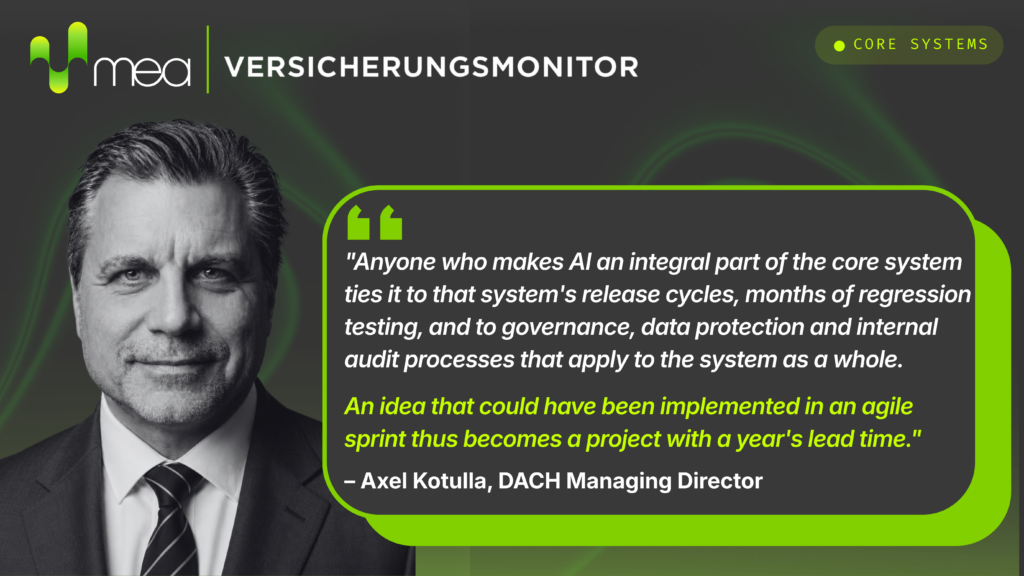
And it is precisely in this reassessment that the Kodak mistake is being repeated. Several established system vendors are building AI functions directly into their policy administration systems in order to unlock efficiency gains. That is understandable operationally and in the short term, but in my view short-sighted strategically. In a market that changes in months rather than years, an insurer needs above all one thing, in my view: flexibility. Anyone who makes AI an integral part of the core system ties it to that system’s release cycles, to months of regression testing, and to governance, data protection and internal audit processes that apply to the system as a whole. Every new AI capability, however small, triggers the same audit process as a complete new version of the core system. An idea that could have been implemented in an agile sprint thus becomes a project with a year’s lead time.
A second, often overlooked effect follows: anyone who delivers AI exclusively through their own core system limits their own reach and forgoes sales opportunities. The innovation reaches only those customers who already use that one core system. All the others, who work with a different vendor or with an organically grown, heterogeneous system landscape, are left out. Whether built-in AI will persuade anyone to buy an entire core system and spend years implementing it can, at the very least, also be questioned. That too is reminiscent of Kodak: defending an existing ecosystem instead of taking the new technology to where the market needs it.
A Debate the Wrong Way Around
The debate is already being conducted openly, just mostly the wrong way round. When system providers currently argue that AI should be ‘built in, not bolted on’ because a core system largely consists of specialist expertise that AI will not replace anyway, there is both a kernel of truth and a momentous error of thinking in it. What is right: specialist expertise remains valuable. What is wrong is the conclusion that this expertise must therefore be delivered in the same release rhythm as the core. This equation of business logic with coupling to the core system is the error Kodak made with film grain: the expertise was never the problem; the coupling to the wrong carrier medium was.
The same applies to the frequently used argument that AI has direct access to data, processes and product modelling only if it is anchored in the core. This confuses access with residence, and dates from a time when we were still debating performance at interfaces. A core system that offers its business logic through clean services – today via REST (Representational State Transfer), increasingly via agent protocols such as MCP – provides an external module with the same data, checks and product rules, only in a controlled and logged manner. Transactions are still posted in the core: the AI makes a proposal; the policy administration system checks it deterministically and updates the records. And for hardly any insurer is the core the whole truth: documents sit in document management, correspondence in the CRM, payments in premium collection. Anyone who looks only from the core outwards has not a better view but a narrower one.
A further argument: AI-supported customer dialogue makes sense only with direct access to policy and
contract data. The first part is true: without contract data, every assistant remains an FAQ machine. The conclusion that only AI within the policy administration system can achieve this is not true. Most insurers operate several policy administration systems, for life, health and general insurance (non-life), sometimes even several per line of business, and in addition CRM systems, separate partner systems or risk systems.
An assistant anchored in the core provides information only about the contracts that sit in that core: the customer with home contents, motor and pension insurance ends up with three assistants that know
nothing about one another. And a question such as ‘Why has my premium gone up?’ is not answered from the policy table, but from the policy, the premium adjustment letter, the claims history and the policy wording together. A loosely coupled AI layer reads all four sources. The built-in
assistant reads one of them particularly well.
This is where the advantage of loose coupling becomes apparent. Lightweight, AI-native platforms deliberately start not at the core but alongside it: an independent AI layer that communicates with the core system via interfaces without touching it. New functions, from document capture through risk assessment in underwriting to claims handling, can be put into production within weeks, because only the module itself has to be signed off.
Three further benefits come into play. Image models are renewed on a quarterly rhythm: a better model for claims photos shortens claims settlement times immediately if only the module has to be signed off, whereas the next core release is not due for another six months. A module can be versioned individually and, if in doubt, switched off; a core release cannot be rolled back, which makes risk classification, logging and oversight under the EU AI Act easier. And the same module serves insurers, brokers and MGAs, including those without the vendor’s core system. This creates competition and flexibility, in that customers can implement modules step by step without having to build interim solutions continuously because dependencies have to be served.
In Some Cases, AI in the Core Makes Sense
To avoid any misunderstanding: in some cases AI really does belong in the core, namely where it operates within the transaction, for example in plausibility checks during data capture. In most cases, however, this is not so.
My recommendation to established system vendors is therefore: decouple your systems. Do as SAP did 50 years ago. Operate from a robust core that reliably manages policy administration and accounting, and attach to it independent modules and AI functions that work on their own but deliver real added value when used together. In this way, new customers can be brought on board step by step without having to replace the entire core system, while existing customers are supplied with new functions in parallel. Growth then arises not despite the architecture, but because of it.
This development is also being described beyond the debate in the DACH region. The Indian businessman Jay Mehta puts it in a highly interesting LinkedIn post: the core is losing its position at the centre, not because it is becoming less important, but because the real work is shifting into the ecosystem around it. Submission, enrichment, triage, pricing and customer journeys increasingly take place alongside the core, while the core, as the system of record, holds the trusted state of the business. Taking claims as an example, this means concretely: intake, document understanding and coverage checks take place in the environment around the core, and only the relevant transactions and decisions are written back.
A second, independent confirmation: in its study ‘Core insurance system transformation in the age of AI’ of August 2026, Roland Berger aptly calls the principle ‘Hollowing the Core’. In it, core systems shrink to pure systems of record: underwriting, claims, finance and accounting. Product configuration, rule sets, pricing workflows and even policy administration migrate into separate best-of-breed solutions, with the stated aim of cutting time to market from the current three to five months to a few days.
Domain-specific solutions are thus gaining in importance, while large core systems shrink to calculation and
accounting. What remains is a three-layer model: at the top, the AI layer for understanding and decision-making; below it, the slim core system for calculation; and as the foundation, a central data lake to which all systems have access, not only the core system. The AI layer runs as a service for several systems at once, not as an appendage of a single core. Only then does genuine end-to-end integration emerge, and only then does the discussion about policy administration become one about genuine competitiveness and competitive advantages.
Axel Kotulla is Managing Director DACH at mea Platform, a provider of an AI-supported platform for insurance operations. In the column ‘The Long View’, we invite industry experts to write about the background to the state of the industry.
-
-
The back office absorbs roughly half of broker margin, which makes the selection of an agentic AI platform one of the more consequential technology…
-
The missing point in the buy vs. build debate is that an AI system is not a fixed asset that depreciates on a schedule;…
-
InsureThink By Martin P.D. Henley Chief Executive Officer, mea Platform Published August 3, 2026, 6:00 a.m. EDT. Updated August 3, 2026, 6:03 a.m. EDT.…
-
As AI moves from experimentation into core insurance operations, governance can no longer live only in policy documents and oversight committees; it must be…
-
Insurance has spent decades investing in processes, systems, and back-office operations, yet true competitive differentiation remains elusive. Elliott Bundy, CMO of mea Platform, argues…

Cut the drag. Just win.